
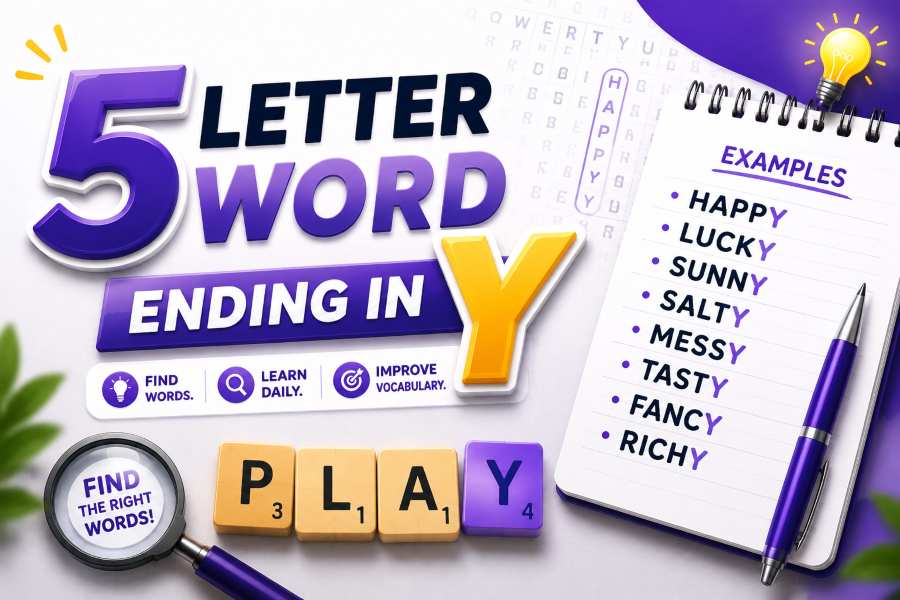
Are you searching for a 5 letter word ending in Y? You may need one for Wordle, Scrabble, Words With Friends, a crossword puzzle, a spelling exercise, or a vocabulary lesson.
Common examples include angry, apply, badly, candy, carry, daily, early, empty, enjoy, every, fancy, funny, happy, heavy, hobby, hurry, jelly, lucky, money, party, ready, reply, salty, scary, story, study, sunny, tasty, today, worry, and young.
The required pattern is _ _ _ _ Y, meaning the word must contain exactly five letters and end with Y. Large word-finder websites provide hundreds of matches, but they do not always use the same inclusion rules. Some include uncommon, regional, technical, informal, or game-specific words alongside normal everyday vocabulary.
Ending in Y
Quick List of 5 Letter Words Ending in Y
| ABBEY | AGONY | ALLAY |
| ALLEY | ALLOY | AMITY |
| AMPLY | ANGRY | ANNOY |
| APTLY | ARRAY | ARTSY |
| ASSAY | AUNTY | BADLY |
| BAGGY | BALMY | BANDY |
| BATTY | BAWDY | BEADY |
| BEAKY | BEAMY | BELLY |
| BENDY | BERRY | BILLY |
| BITTY | BOBBY | BOGEY |
| BOGGY | BONEY | BONNY |
| BOOBY | BOOKY | BOOMY |
| BOOTY | BOSSY | BUDDY |
| BUFFY | BUGGY | BULKY |
| BULLY | BUMPY | BUNNY |
| BURLY | BUSHY | BUZZY |
| BYWAY | CABBY | CADDY |
| CAGEY | CAMPY | CANDY |
| CANNY | CARRY | CATTY |
| CHEVY | CHEWY | COBBY |
| COCKY | COLEY | COMFY |
| CONEY | COOKY | CORKY |
| CORNY | COSEY | COVEY |
| CRAZY | CURLY | CURRY |
| CURVY | CUSHY | DADDY |
| DAILY | DAIRY | DAISY |
| DANDY | DEARY | DECAY |
| DECOY | DECRY | DEIFY |
| DEITY | DELAY | DERBY |
| DIARY | DICEY | DILLY |
| DIMLY | DINGY | DINKY |
| DIPPY | DIRTY | DITTY |
| DIZZY | DODGY | DOGGY |
| DOILY | DOLLY | DOPEY |
| DORKY | DOTTY | DOWNY |
| DOWRY | DRYLY | DUMMY |
| DUMPY | DUSKY | DUSTY |
| EARLY | EBONY | EDIFY |
| ELEGY | EMERY | EMPTY |
| ENEMY | ENJOY | ENTRY |
| ENVOY | EPOXY | ESSAY |
| FAIRY | FANCY | FATTY |
| FELLY | FERRY | FIERY |
| FIFTY | FILLY | FILMY |
| FISHY | FIZZY | FLAKY |
| FLAMY | FLAWY | FLUEY |
| FLUKY | FLYBY | FOAMY |
| FOGEY | FOGGY | FOLLY |
| FORAY | FORTY | FULLY |
| FUNKY | FUNNY | FURRY |
| FUSSY | FUZZY | GAILY |
| GAMEY | GASSY | GAUDY |
| GAWKY | GAYLY | GELLY |
| GIDDY | GILLY | GIRLY |
| GLARY | GLAZY | GLORY |
| GLUEY | GOATY | GODLY |
| GOLLY | GOOEY | GOOFY |
| GRIMY | GULLY | GUMMY |
| GUSTY | GUTSY | GYPSY |
| HAPPY | HARDY | HARRY |
| HASTY | HEAVY | HEFTY |
| HILLY | HIPPY | HOARY |
| HOBBY | HONEY | HOOKY |
| HORNY | HUSKY | ICILY |
| IMPLY | INLAY | IRONY |
| ITCHY | IVORY | JUICY |
| JUMPY | KINKY | KITTY |
| LEAFY | LEAKY | LEERY |
| LEFTY | LEGGY | LOUSY |
| LUCKY | LUMPY | LUSTY |
| MANLY | MATEY | MEALY |
| MEATY | MESSY | MILKY |
The table focuses on recognizable and practical words. Broader lists may include many more obscure terms, names, dialect words, and game-valid forms. Merriam-Webster offers a common-word filter, while WordFinder displays both familiar words and much less common entries such as specialized spellings and game vocabulary.
What Does “Ending in Y” Mean?
A five-letter word ending in Y follows this structure:
First letter + second letter + third letter + fourth letter + Y
For example:
- A + N + G + R + Y = angry
- C + A + N + D + Y = candy
- H + A + P + P + Y = happy
- M + O + N + E + Y = money
- S + T + O + R + Y = story
The word may contain another Y before the final position, although this is less common. Yummy begins with Y and also ends with Y.
A search for words “containing Y” is much broader. For this topic, Y must appear as the fifth and final letter.
Common 5 Letter Words Ending in Y
Many Y-ending words appear frequently in everyday speech and writing.
Angry
Angry means feeling strong displeasure or annoyance.
Example: She felt angry about the unfair decision.
Apply
Apply can mean to submit a request, put something onto a surface, or use a rule or idea.
Example: You can apply for the position online.
Badly
Badly means in an unsuccessful, harmful, or severe way.
Example: The old fence was badly damaged.
Candy
Candy is a sweet food usually made with sugar.
Example: The children shared a bag of candy.
Carry
Carry means to hold and move something from one place to another.
Example: Please carry the box carefully.
Daily
Daily means happening every day. It can function as an adjective or adverb.
Example: Walking is part of her daily routine.
Early
Early means before the expected or usual time.
Example: We arrived early for the appointment.
Empty
Empty means containing nothing. It can also be used as a verb.
Example: The bottle was empty.
Enjoy
Enjoy means to take pleasure in something.
Example: We enjoy spending time outdoors.
Every
Every refers to each member of a group.
Example: Every student received a worksheet.
Fancy
Fancy can mean decorative, expensive, complicated, or imaginative. As a verb, it can mean to like or desire something.
Example: They booked a fancy restaurant.
Funny
Funny can mean humorous, strange, or suspicious.
Example: The story was surprisingly funny.
Happy
Happy means feeling pleased, satisfied, or joyful.
Example: She was happy with the results.
Heavy
Heavy means having a lot of weight or being difficult to lift.
Example: The suitcase was too heavy to carry alone.
Hobby
A hobby is an activity done regularly for enjoyment.
Example: Gardening is her favorite hobby.
Hurry
Hurry means to move or act quickly.
Example: We must hurry or we will miss the train.
Jelly
Jelly is a soft food made from fruit juice, sugar, and a setting ingredient. It can also describe a soft or gelatin-like substance.
Example: He spread jelly on the toast.
Lucky
Lucky means having good fortune.
Example: We were lucky to find the missing keys.
Money
Money is a system of coins, notes, or digital value used to buy goods and services.
Example: She saved money for the trip.
Party
A party is a social gathering, a political group, or one side in an agreement or dispute.
Example: They held a small birthday party.
Ready
Ready means prepared for an activity or situation.
Example: The team is ready to begin.
Reply
Reply means to answer or respond.
Example: Please reply to the message by Friday.
Salty
Salty means containing, tasting of, or covered with salt.
Example: The soup was too salty.
Scary
Scary means causing fear.
Example: The movie was too scary for young children.
Story
A story is an account of real or imagined events.
Example: She told us a funny story.
Study
Study means to learn about a subject through reading, research, or practice. It can also be a noun.
Example: They study English every evening.
Sunny
Sunny means bright with sunlight or cheerful in personality.
Example: It was a warm and sunny afternoon.
Tasty
Tasty means having a pleasant flavor.
Example: The meal was simple but tasty.
Today
Today means the current day.
Example: The office is closed today.
Worry
Worry means to feel anxious or concerned.
Example: Try not to worry about minor mistakes.
Young
Young means having lived or existed for only a short time.
Example: The young tree needs regular watering.
5 Letter Words Ending in Y by Their Final Two Letters
Sorting words by the letters before Y can make it easier to solve puzzles.
5 Letter Words Ending in AY
Common examples include allay, array, assay, decay, delay, essay, foray, inlay, relay, spray, stray, and today.
This is one of the most useful Y-ending groups. The 7ESL list also includes less common AY words such as belay, byway, copay, satay, and vacay.
5 Letter Words Ending in BY
Examples include busby, and hubby in informal use.
Some broad word-game lists include uncommon or regional BY endings, so unfamiliar entries should be checked before use.
5 Letter Words Ending in CY
Examples include fancy, juicy does not belong because it ends in CY only if spelled J-U-I-C-Y, which it is, and spicy.
Other examples include dicey, mercy, and saucy.
5 Letter Words Ending in DY
Examples include bawdy, beady, biddy, buddy, candy, hardy, handy, muddy, needy, nerdy, rowdy, sandy, seedy, study, and windy.
This group contains many familiar adjectives.
5 Letter Words Ending in EY
Examples include alley, honey, money, mosey, and poney in uncommon or nonstandard usage.
Common standard options include alley, honey, and money.
5 Letter Words Ending in FY
Examples are limited. Some English verbs ending in -fy have more than five letters, such as clarify and justify.
Broad dictionaries may include rare or shortened forms, but these are not common everyday words.
5 Letter Words Ending in GY
Examples include baggy, boggy, doggy, foggy, mangy, muggy, soggy, and zingy.
These words often describe texture, appearance, weather, or condition.
5 Letter Words Ending in HY
Examples include bushy, cushy, fishy, itchy, mushy, pushy, and rushy.
WordFinder’s US-plus-Y list includes musky, busby, husky, bushy, cushy, dusky, mushy, and pushy, showing how ending-pattern pages often combine common and less familiar options.
5 Letter Words Ending in IY
Standard five-letter English words ending in IY are extremely rare. Results in broad databases may be transliterations, names, or nonstandard forms.
5 Letter Words Ending in JY
This ending is very uncommon in standard English.
5 Letter Words Ending in KY
Examples include cocky, dinky, funky, gawky, husky, lucky, murky, perky, pinky, risky, rocky, smoky, sulky, tacky, wonky, and yucky.
Many KY-ending words are informal or descriptive adjectives.
5 Letter Words Ending in LY
Examples include amply, aptly, badly, burly, daily, dimly, dryly, early, fully, gaily, godly, hotly, jolly, lowly, madly, newly, oddly, sadly, silly, truly, and wryly.
Words ending in LY are often adverbs, though some function as adjectives.
5 Letter Words Ending in MY
Examples include balmy, filmy, foamy, gummy, loamy, palmy, slimy, and stormy does not belong because it has six letters.
Other five-letter options include dummy and mummy, although these end in MMY rather than a simple vowel-plus-MY pattern.
5 Letter Words Ending in NY
Examples include bunny, corny, downy, funny, horny, penny, rainy, runny, sunny, tawny, and tinny.
This group includes several common descriptive words.
5 Letter Words Ending in OY
Examples include alloy, annoy, decoy, enjoy, envoy, and savoy.
Enjoy is especially useful in Wordle and everyday writing because it contains five different letters.
5 Letter Words Ending in PY
Examples include bumpy, dumpy, happy, lumpy, nappy, peppy, poppy, puppy, sappy, and tipsy does not belong because it ends in SY.
Many PY-ending words repeat the letter P.
5 Letter Words Ending in QY
Standard English words ending in QY are extremely rare.
5 Letter Words Ending in RY
Examples include angry, berry, carry, curry, dairy, diary, fairy, fiery, furry, glory, gravy, hairy, marry, merry, mercy, scary, story, weary, and worry.
This is one of the largest and most useful ending groups.
5 Letter Words Ending in SY
Examples include artsy, bossy, busy has four letters, classy has six letters, daisy, easy has four letters, fussy, hussy, messy, mossy, noisy, pansy, pasty, sassy, tipsy, and tousy in uncommon use.
Common five-letter options include artsy, daisy, fussy, messy, mossy, noisy, pansy, pasty, sassy, and tipsy.
5 Letter Words Ending in TY
Examples include amity, batty, bitty, catty, deity, dirty, fatty, forty, hasty, lofty, minty, musty, nasty, nutty, party, petty, salty, tasty, and unity.
Many TY-ending words are adjectives, but some are nouns.
5 Letter Words Ending in UY
Standard five-letter English words ending in UY are uncommon. Some databases may include borrowed or regional terms.
5 Letter Words Ending in VY
Examples include envy with four letters and privy, which has five.
Privy can mean private or informed about something.
5 Letter Words Ending in WY
Words ending in WY are rare. Broad word lists may contain dialectal or uncommon forms.
5 Letter Words Ending in XY
Examples include epoxy and proxy.
These are useful in Scrabble because X is a high-value tile.
5 Letter Words Ending in YY
Standard English words ending in YY are extremely rare.
5 Letter Words Ending in ZY
Examples include crazy, dizzy, fizzy, fuzzy, jazzy, muzzy, and woozy.
WordFinder places high-value Z words such as jazzy, buzzy, fuzzy, muzzy, fizzy, dizzy, and woozy near the top of its score-sorted list.
5 Letter Words Ending in Y for Wordle
When Wordle confirms that Y is the fifth letter, the pattern becomes:
_ _ _ _ Y
The best next guess depends on the letters already marked green, yellow, and gray.
Words With Five Different Letters
Words with no repeated letters can test more possibilities:
- Agony
- Amity
- Angry
- Artsy
- Balmy
- Candy
- Carry has a repeated R, so it is not included here
- Daily
- Daisy
- Decoy
- Diary
- Early
- Ebony
- Elegy
- Empty
- Enjoy
- Entry
- Envoy
- Epoxy
- Fairy
- Fancy
- Fiery
- Forty
- Glory
- Gravy
- Hairy
- Honey
- Ivory
- Lucky
- Mercy
- Money
- Party
- Privy
- Proxy
- Rainy
- Ready
- Relay
- Reply
- Salty
- Scary
- Story
- Study
- Tasty
- Today
- Unity
- Weary
- Worry has a repeated R, so it is better used later
- Young
Words such as angry, daily, early, enjoy, money, party, ready, story, study, and today test several common letters.
Words With Repeated Letters
Some Y-ending words repeat a character:
- Abbey
- Alley
- Annoy
- Apply
- Baggy
- Batty
- Belly
- Berry
- Bossy
- Bunny
- Carry
- Dally
- Dizzy
- Funny
- Fuzzy
- Happy
- Jelly
- Jazzy
- Jolly
- Kitty
- Merry
- Messy
- Mummy
- Penny
- Poppy
- Puppy
- Silly
- Sunny
- Witty
- Woolly
- Worry
- Yummy
Repeated-letter words are useful when clues suggest that a letter appears more than once. Early in a game, they test fewer unique letters.
Words With Multiple Vowels
Y-ending words containing several standard vowels include:
- Abbey
- Agony
- Allay
- Amity
- Array
- Assay
- Daily
- Daisy
- Decay
- Decoy
- Deity
- Diary
- Ebony
- Elegy
- Empty
- Enemy
- Enjoy
- Entry
- Envoy
- Epoxy
- Essay
- Fairy
- Fiery
- Gaily
- Honey
- Ivory
- Money
- Noisy
- Rainy
- Ready
- Relay
- Today
- Unity
- Weary
- Woody
These can help reveal whether the word contains A, E, I, O, or U in addition to the final Y.
Useful Starting-Letter Groups
If you know the first letter, narrow the list further.
Words beginning with B include badly, baggy, balmy, batty, bawdy, beady, beefy, belly, berry, bitty, boggy, bossy, bumpy, bunny, burly, bushy, and busty.
Words beginning with C include candy, carry, catty, comfy, corny, crazy, curly, and curry.
Words beginning with D include daily, daisy, dally, decay, decoy, deity, derby, diary, dicey, dirty, dizzy, doggy, doily, dowry, dryly, and dummy.
Words beginning with H include hairy, handy, happy, hardy, hasty, heavy, hobby, holly, honey, hurry, and husky.
Words beginning with S include sadly, salty, sandy, saucy, scary, seedy, silky, silly, smoky, snowy, soggy, spicy, spiky, spray, story, stray, study, sunny, and surly.
Choosing a Strong Wordle Guess
Choose a word that:
- Matches all green letters
- Moves yellow letters into new positions
- Avoids known gray letters
- Tests common consonants
- Includes useful vowels
- Avoids repeated letters unless duplication is likely
Words such as angry, daily, early, enjoy, money, party, ready, story, study, and today may be useful because they contain practical letter combinations.
Not every dictionary word is accepted by Wordle, and an accepted guess is not necessarily a possible answer. WordFinder explicitly presents its Y-ending list as a resource for Wordle, Scrabble GO, and Words With Friends, but the games do not all use identical dictionaries.
High-Scoring Scrabble Words Ending in Y
Y itself is worth four points in standard English-language Scrabble, so many Y-ending words can be useful. Words containing J, Z, X, K, or F may score especially well.
High-value examples include:
- Jazzy
- Fizzy
- Fuzzy
- Dizzy
- Buzzy
- Woozy
- Zingy
- Epoxy
- Proxy
- Crazy
- Jolly
- Jelly
- Lucky
- Husky
- Funky
- Wacky
- Yucky
WordFinder’s score-sorted results place jazzy, buzzy, fuzzy, muzzy, fizzy, and dizzy among the strongest five-letter Y-ending options because they combine Y with one or more high-value letters.
Why These Words Score Well
The letter Z is worth ten points in standard Scrabble, making words such as jazzy, fuzzy, fizzy, dizzy, and crazy valuable.
The letter J is worth eight points, which helps jazzy, jelly, and jolly.
The letter X is worth eight points, making epoxy and proxy strong options.
The letter K is worth five points, which increases the value of husky, lucky, funky, murky, perky, and risky.
Board Position Matters
A high base score does not always produce the best move. A lower-value word may earn more if it reaches a premium square, creates parallel words, or opens a useful extension.
Before playing an uncommon term, confirm that it is accepted in the dictionary used by your game.
Easy Five-Letter Words Ending in Y for Children
Children and beginning English learners should start with familiar words that have simple meanings.
Good options include:
- Angry
- Apply
- Badly
- Candy
- Carry
- Daily
- Daisy
- Early
- Empty
- Enjoy
- Every
- Fairy
- Fancy
- Funny
- Happy
- Heavy
- Hobby
- Honey
- Hurry
- Jelly
- Lucky
- Money
- Party
- Rainy
- Ready
- Reply
- Salty
- Sandy
- Scary
- Silly
- Story
- Study
- Sunny
- Tasty
- Today
- Worry
- Young
- Yummy
Simple Spelling Activity
Complete the missing letters:
- H A P P _
- C A N D _
- M O N E _
- S T O R _
- S U N N _
The completed words are happy, candy, money, story, and sunny.
Word Grouping Activity
Ask learners to group the words by meaning.
Feeling words include angry, happy, moody, scary, and weary.
Weather words include rainy, snowy, sunny, windy, and foggy.
Food-related words include candy, curry, gravy, honey, jelly, salty, spicy, tasty, and yummy.
Describing words include heavy, lucky, messy, pretty, ready, silly, smart does not end in Y, and young.
Uncommon Five-Letter Words Ending in Y
Some Y-ending words are legitimate but less common in everyday conversation.
Amity
Amity means friendship or peaceful relations.
Example: The agreement was intended to promote amity between the two groups.
Amply
Amply means more than enough or sufficiently.
Example: The evidence amply supported the conclusion.
Artsy
Artsy informally describes something connected with art or made to appear artistic.
Example: The neighborhood has an artsy atmosphere.
Assay
An assay is a test used to determine the composition or quality of a substance. As a verb, it means to analyze or examine.
Example: The laboratory performed an assay on the sample.
Bawdy
Bawdy describes humor or language that is indecent in a playful or comic way.
Balmy
Balmy usually describes pleasantly warm weather. It may also have an older informal meaning related to foolishness.
Elegy
An elegy is a mournful poem, song, or piece of writing, often about someone who died.
Envoy
An envoy is an official representative sent on a diplomatic mission.
Epoxy
Epoxy is a strong resin or adhesive.
Privy
Privy means informed about something private. It can also refer to an outdoor toilet in older usage.
Proxy
A proxy is someone or something authorized to act for another.
Surly
Surly means unfriendly, bad-tempered, or rude.
Tawny
Tawny means yellowish-brown or orange-brown.
Wryly
Wryly means in a dry, mocking, or slightly ironic way.
These words may be useful in writing and word games, but their meanings and tones should be understood before use.
Five-Letter Y-Ending Words by Part of Speech
Understanding grammar can help you choose the correct word.
Nouns
Common nouns include abbey, agony, alley, alloy, amity, aunty, berry, candy, daisy, deity, derby, diary, doily, dowry, elegy, enemy, entry, envoy, epoxy, essay, fairy, glory, gravy, hobby, honey, ivory, jelly, kitty, mercy, money, party, penny, poppy, proxy, puppy, story, study, and unity.
Verbs
Verbs include allay, annoy, apply, array, assay, carry, dally, decay, delay, enjoy, hurry, marry, rally, relay, reply, spray, study, and worry.
Adjectives
Many Y-ending words are adjectives, including angry, artsy, badly is usually an adverb, baggy, balmy, batty, bawdy, beady, beefy, bossy, bumpy, burly, bushy, candy can also be descriptive informally, catty, corny, crazy, curly, dirty, dizzy, early, empty, fancy, fatty, fiery, fishy, flaky, foggy, funny, furry, gaudy, goofy, grimy, hairy, handy, happy, hardy, hasty, heavy, itchy, jazzy, juicy, lanky, leafy, leaky, lofty, lucky, lumpy, mangy, messy, milky, minty, misty, moody, mossy, muddy, murky, musty, nasty, needy, nerdy, noisy, nutty, perky, petty, picky, pretty, puffy, rainy, ready, rocky, roomy, rowdy, rusty, salty, sandy, saucy, scary, seedy, silky, silly, smoky, snowy, soggy, spicy, spiky, sunny, surly, tasty, tawny, tipsy, weary, windy, witty, woody, woolly, yummy, and zesty.
Adverbs
Common adverbs include amply, aptly, badly, daily, dryly, early, fully, gaily, madly, newly, oddly, sadly, truly, and wryly.
Words With More Than One Grammatical Role
Early can be an adjective or adverb.
“The early train arrived on time.”
“We arrived early.”
Fancy can be an adjective, noun, or verb.
“They booked a fancy hotel.”
“The design caught her fancy.”
“Do you fancy a walk?”
Study can be a noun or verb.
“The study examined reading habits.”
“They study every evening.”
Reply can be a noun or verb.
“Her reply was brief.”
“Please reply today.”
Worry can be a noun or verb.
“Financial worry can affect sleep.”
“Try not to worry.”
Frequently Confused Five-Letter Words Ending in Y
Dairy and Diary
Dairy relates to milk products or a place where they are produced.
Diary is a personal written record.
Both contain five letters and end in Y.
Example: She wrote in her diary after visiting the dairy farm.
Fairy and Ferry
Fairy is an imaginary magical being.
Ferry is a boat used to carry people or vehicles across water.
Both end in Y, but their spellings and meanings are different.
Hairy and Harry
Hairy means covered with hair.
Harry is usually a proper name or a verb meaning to trouble or attack repeatedly.
Only hairy is normally appropriate in a general common-word list without treating it as a name.
Money and Honey
Money refers to currency or financial value.
Honey is a sweet substance made by bees.
The words rhyme but have different first letters and meanings.
Story and Storey
Story is an account of events.
Storey is a British spelling for one level of a building and has six letters.
Only story fits the five-letter pattern.
Weary and Worry
Weary means tired.
Worry means to feel anxious.
Both end in Y but have different vowel patterns.
Daily and Daisy
Daily means every day.
Daisy is a type of flower.
Only one letter differs, so these words are easy to confuse in puzzles.
Salty and Silty
Salty means containing or tasting of salt.
Silty means containing fine soil or sediment called silt.
Both are valid five-letter Y-ending adjectives.
Why Different Word Lists Show Different Totals
Different websites may show different numbers of five-letter words ending in Y.
Merriam-Webster separates common words from its broader dictionary collection. WordFinder includes game-oriented entries and sorts them by scores, while 7ESL publishes a very large educational list that claims more than 1,500 examples. These sources are not using identical databases or definitions of what belongs in the category.
A list may include:
- Common modern English words
- Inflected word forms
- Informal vocabulary
- Regional and dialect words
- Archaic terms
- Technical language
- Proper names
- Borrowed words
- Scrabble-valid entries
- Words With Friends entries
For this reason, there is no universal total that applies to every dictionary and game.
How to Choose the Right Five-Letter Y Word
The correct choice depends on what you are doing.
For Wordle
Match all green letters, move yellow letters into new positions, and avoid gray letters. Use words with five distinct characters when you still need broad information.
For Scrabble
Check the approved dictionary, tile values, board position, premium squares, parallel-word opportunities, and possible extensions.
For Crosswords
Consider the clue’s meaning, part of speech, tense, singular or plural form, and intersecting letters.
For Vocabulary Practice
Start with familiar options such as angry, candy, daily, early, empty, enjoy, every, funny, happy, heavy, hobby, honey, lucky, money, party, ready, story, study, sunny, tasty, today, worry, and young.
For Formal Writing
Confirm the meaning and tone of uncommon words. A game-valid term may not be suitable in professional or academic communication.
Frequently Asked Questions
What is a five-letter word ending in Y?
A five-letter word ending in Y contains exactly five letters, with Y in the final position. Examples include angry, candy, early, empty, enjoy, fancy, funny, happy, money, party, ready, story, study, sunny, today, worry, and young.
What is the pattern for five-letter words ending in Y?
The pattern is _ _ _ _ Y. Four letters come before the final Y.
What are common five-letter words ending in Y?
Common examples include angry, apply, badly, candy, carry, daily, early, empty, enjoy, every, fancy, funny, happy, heavy, hobby, hurry, jelly, lucky, money, party, ready, reply, salty, scary, story, study, sunny, tasty, today, worry, and young.
What five-letter words end in AY?
Examples include allay, array, assay, decay, delay, essay, foray, inlay, relay, spray, stray, and today.
What five-letter words end in LY?
Examples include amply, aptly, badly, burly, daily, dryly, early, fully, gaily, godly, hotly, jolly, lowly, madly, newly, oddly, sadly, silly, truly, and wryly.
What five-letter words end in NY?
Examples include bunny, corny, downy, funny, horny, penny, rainy, runny, sunny, tawny, and tinny.
What five-letter words end in RY?
Examples include angry, berry, carry, curry, dairy, diary, fairy, fiery, furry, glory, gravy, hairy, marry, merry, mercy, scary, story, weary, and worry.
What five-letter words end in TY?
Examples include amity, batty, bitty, catty, deity, dirty, fatty, forty, hasty, lofty, minty, musty, nasty, nutty, party, petty, salty, tasty, and unity.
What Wordle words end in Y?
Useful possibilities include agony, amity, angry, artsy, balmy, candy, daily, daisy, decoy, diary, early, ebony, empty, enjoy, entry, envoy, epoxy, fairy, fancy, fiery, forty, glory, gravy, honey, ivory, lucky, mercy, money, party, privy, proxy, rainy, ready, relay, reply, salty, scary, story, study, tasty, today, unity, weary, and young.
What are high-scoring Scrabble words ending in Y?
Jazzy, buzzy, fuzzy, fizzy, dizzy, woozy, epoxy, proxy, crazy, jelly, jolly, lucky, husky, funky, and yucky can score well because they contain high-value letters.
Are all five-letter Y-ending words accepted in Wordle?
No. Wordle, Scrabble, Words With Friends, and general dictionaries use different word lists. A valid word in one source may not be accepted in another.
Can a five-letter word contain more than one Y?
Yes. Yummy begins with Y and ends with Y. Some uncommon or specialized words may also contain Y more than once.
Final Thoughts
A 5 letter word ending in Y follows the pattern _ _ _ _ Y. Familiar examples include angry, candy, daily, early, empty, enjoy, every, funny, happy, money, party, ready, story, study, sunny, tasty, today, worry, and young.
For Wordle, choose a word that matches all known clues and tests useful new letters. For Scrabble, confirm dictionary validity and consider tile value and board position. For crosswords, schoolwork, and vocabulary practice, focus on the clue, meaning, spelling, and grammatical role.
The first table gives you a quick reference list, while the remaining sections help you narrow the choices by letter pattern, difficulty, meaning, and intended use.